Illness does not always announce itself loudly. Sometimes it arrives quietly, settles in, and slowly rearranges your life while you are busy pretending everything is fine.
By the time I came to understand this, I was already living inside a body I no longer recognised.
I was 30 years old, an IT specialist with two young children and Multiple Sclerosis entered my life without invitation.
Modern medicine, while careful, precise, and well-intentioned, had begun to feel like a foreign language that was directed at someone else.
I distinctly remember the moment when my treatment stopped feeling like care. My appointments seemed to blur together. My symptoms were being measured but not understood and my existence felt like it was reduced to a whirlwind of scans and charts, followed by cautious optimism.
It felt like I was being managed, not held.
Somewhere between sterile rooms and rehearsed reassurances, I realised that I was surviving, efficiently, but living poorly.
It was a realisation that frightened me more than the illness itself.
Against advice, expectation, and comfort, I decided to travel alone to a remote corner of Kerala, India, to seek Ayurvedic treatment.
I had heard that Ayurvedic treatment could stop or control demyelination, which is the process where the protective myelin sheath around nerve fibers gets damaged or lost, disrupting the transmission of electrical nerve signals.
This is what leads to neurological problems like muscle weakness, vision loss, or cognitive issues.
Ayurvedic treatment uses herbal treatments and oil therapies to treat the earliest symptoms before the nerves are affected.
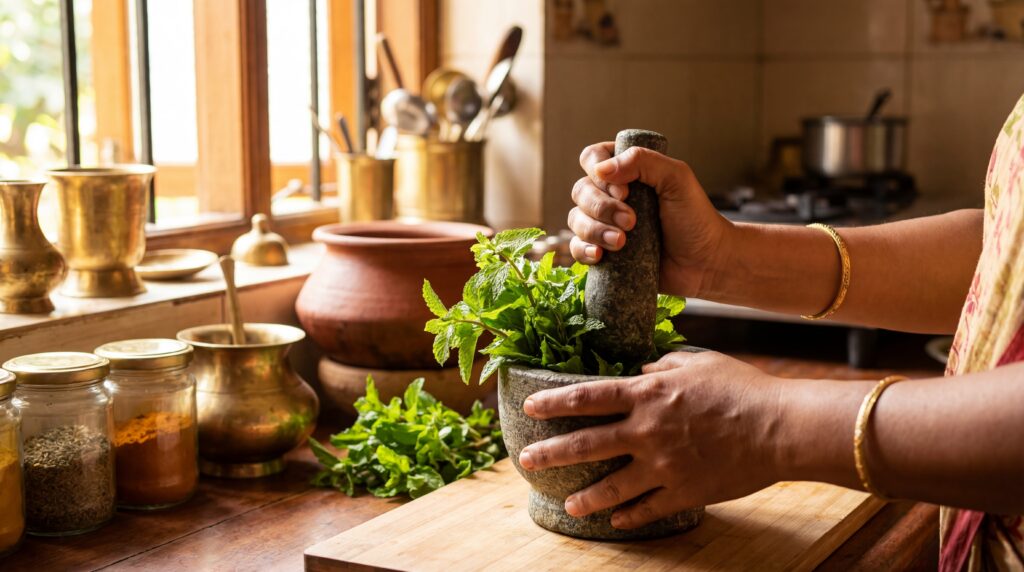
One of Kerala’s specialities is treating Multiple Sclerosis symptoms and this gave me a glimmer of hope. Going to Kerala wasn’t an act of rejection or a romantic escape, but a quiet insistence that my healing had to feel human again.
I needed to reclaim my agency, my intuition and my voice.
While crossing international borders on the long journey from Australia to India, it also felt like I was crossing an internal border.
As cities thinned and greenery thickened, I could feel my body soften in its vigilance. Neverending rows of coconut palms replaced concrete buildings, the air grew heavy with rain and earth and time slowed.
When I arrived, I was embraced in a cocoon of care, where rest wasn’t considered weakness but wisdom, and healing wasn’t demanded, but allowed.
The Ayurvedic centre lay far from urgency, tucked into a landscape that seemed older than any diagnosis itself.
One of the key focuses of Ayurveda is to remove inflammation from the body externally and internally. Therapies like Kizhi involve patting down your body with a cloth bundle that contains warm oil or warm herbal powders. Kerala’s tropical climate was perfect for these treatments.
There were no machines announcing distress, no white coats delivering authority, instead, there were conversations that unfolded gently, hands that worked with intention, and an attention to rhythm rather than results.
The days unfolded with ritualistic simplicity. My bare feet on cool floors, meals prepared for me with care, hands pressing oil into my skin gently. Outside, the rain continued, unapologetic and abundant.
There was no demand for productivity or explanations from me. I was simply allowed to be.
For the first time, I was asked how illness lived inside me, not just where.
Ayurveda speaks of balance, not battle. This philosophy felt radical after years of fighting my body into submission. I had learned to override fatigue, dismiss pain, and apologise for my limits.
Here, I was encouraged to listen instead. Slowness was not something to overcome and healing was treated as a relationship, complex, ongoing, and deeply personal.
It wasn’t easy though, being alone magnified everything for me…
Without familiar anchors, nights were long and fear visited often, especially in the quiet darkness long after my treatments had ended.
There were moments when I doubted myself and worried I had gone too far. Was I asking too much of a body that was already struggling?
But solitude has a way of clarifying the truth. In that isolation, slowly but surely, I was able to reconnect with myself without any distraction.
One of the first things to surface was grief. I mourned the life I had imagined, the ease that I had lost, and the woman I once was.
Multiple Sclerosis had not only changed my body; it had rewritten my entire future. I had ambition, hopes and dreams. Allowing myself to finally acknowledge that the loss had been harrowing for me, was necessary.
Along with the silence, tears were a regular part of the treatment.
But slowly, something inside me shifted.
I stopped asking when I would be better and I started asking how I could be present.
That question altered my understanding of healing. I began to see that improvement is not always measurable, and recovery is not always linear.
Some days brought strength, others brought complete exhaustion, but my relationship with my body eased. I was no longer at war with it, and my mind and body were learning to coexist.
Kerala taught me that healing does not require certainty, but rather, attention. It requires humility and the courage to remain with yourself when nothing is guaranteed. In that space, I rediscovered trust, not in outcomes, but in my capacity to adapt to whatever lay ahead.
When I left Kerala, while nothing had changed, everything had changed.
Multiple Sclerosis was still present with all its symptoms that refused to go away, but I no longer equated worth with productivity or strength with endurance. The journey gave me back the autonomy my chronic illness had slowly stripped from me.
I stopped waiting to be allowed to choose differently.
I no longer needed permission to listen to myself. Rest became valid without explanation, and care became participatory rather than prescribed.
In a world that asks the unwell to comply, endure, and remain grateful, I chose healing instead. I chose to listen to my inner voice and I chose myself.
While I did not find a cure in that quiet, rain-filled place, I found reconciliation, and with it, a sense of wholeness and peace that has long survived any physical shortcomings.
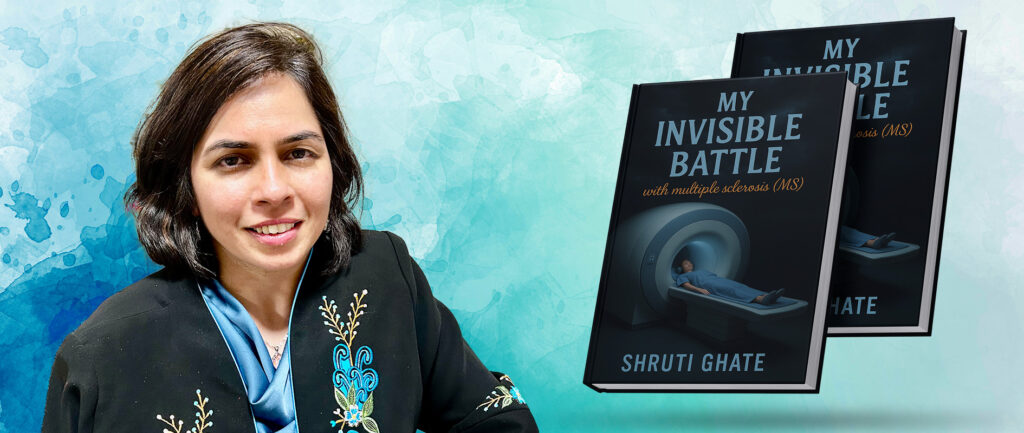
Shruti Ghate is an advocate for Multiple Sclerosis and the author of My Invisible Battle with MS.